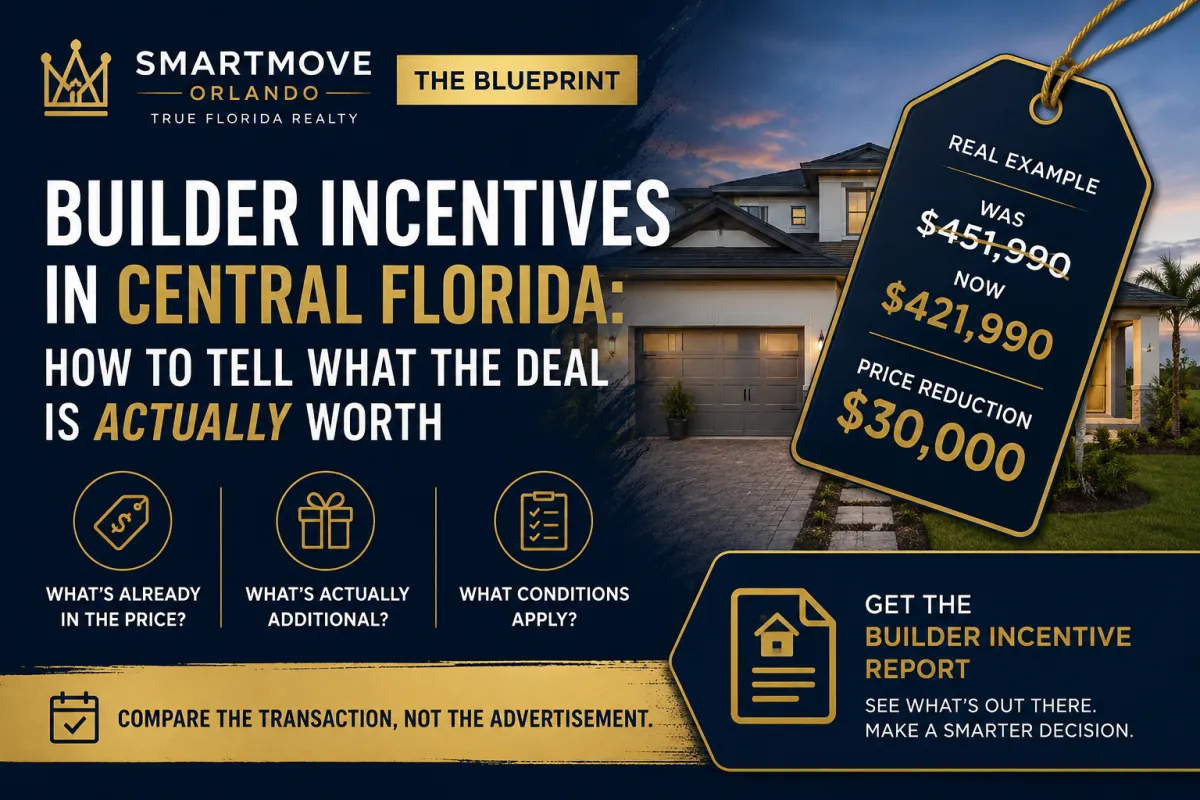
$30K Builder Incentive Explained | Central Florida
A builder’s “$30,000 incentive” is not automatically thirty thousand dollars of extra money for the buyer. It may already be reflected in the advertised price, restricted to specific closing costs, tied to a preferred lender, allocated to a rate buydown, or recovered through a higher contract price. The only way to know what the offer is actually worth is to compare the full transaction—not the headline.
That means comparing the home’s true price, loan amount, monthly payment, cash to close, eligible credits, and appraisal risk side by side.
The $30,000 did—and did not—exist
In a recent Central Florida new-construction transaction, the advertised price was approximately $387,690 and the builder promoted $30,000 in “flex cash.” The buyers initially understood that as an additional thirty thousand dollars they could direct toward their down payment and closing expenses.
That was not how the transaction was structured. The advertised price already reflected part of the incentive economics. When the buyers’ estimated cash needed for closing became clear, the contract structure changed. The final price moved to approximately $403,917, while additional closing-cost assistance was negotiated so the buyers’ cash-to-close problem could be addressed.
The buyers received meaningful help. But the help was not a free pile of cash. It was a financing and contract structure with tradeoffs.
What “builder flex cash” can actually mean
Depending on the community, inventory home, lender, and loan program, a builder incentive may be allocated toward one or more of the following:
Buyer closing costs and prepaid expenses
Discount points or a temporary/permanent interest-rate buydown
Design-center upgrades or lot premiums
A reduction from a higher starting price
A lender credit tied to a particular interest rate
A combination of price, credit, and financing concessions
Those options do not create the same result. Ten thousand dollars applied to closing costs can solve an immediate cash problem. Ten thousand dollars applied to the price may produce only a modest monthly-payment change. Ten thousand dollars used for a permanent rate buydown may affect the payment differently again.
The five-number test every buyer should run
1. What was the price before the incentive?
Ask for the starting price, the advertised price, and the final contract price. If the incentive is already embedded in the advertised number, it should not be counted a second time as additional buyer value.
2. How much credit appears in the contract?
Do not rely on a flyer, text message, or verbal explanation. Identify the exact dollar amount and permitted uses in the purchase agreement, addenda, lender worksheet, and closing disclosures.
3. What is the final cash to close?
The Consumer Financial Protection Bureau explains that estimated cash to close includes the down payment and closing costs, reduced by deposits, seller credits, and other adjustments. This is the number buyers must evaluate—not the incentive headline.
4. What happens to the loan amount and payment?
If credits are supported by a higher sales price, the buyer may be financing part of the closing-cost solution over the life of the loan. That can still be strategically useful when preserving cash is the priority, but it is not the same as receiving free money.
5. Does the home still appraise?
A higher contract price must still work within the lender’s underwriting and appraisal requirements. Financing concessions and sales concessions can affect how an appraiser evaluates the transaction. The lender and appraiser—not the marketing department—control whether the structure survives.
A cleaner way to compare builder offers
QuestionOffer AOffer B Final contract priceLower priceHigher price with credits Buyer cash to closeHigherLower Loan amountLowerPotentially higher Monthly paymentCompare with actual rateCompare after buydown/credits Credit restrictionsConfirm eligible usesConfirm eligible uses Appraisal exposureReviewReview carefully
The strongest offer is the one that solves the buyer’s real constraint. For one buyer, that may be the lowest monthly payment. For another, it may be preserving cash for reserves, moving expenses, or repairs. A large incentive can be valuable—but only when it is allocated to the buyer’s actual objective.
Questions to ask before signing
Is the incentive already included in the advertised price?
Can it be used for down payment, closing costs, prepaid expenses, rate buydown, or upgrades?
Is use of the builder’s preferred lender or title company required?
What happens to the incentive if I use an outside lender?
What is the final loan amount, payment, and cash to close?
Are any unused credits forfeited?
Does the contract price need to increase to generate the credit?
What appraisal or underwriting limits apply?
Frequently asked questions
Can builder incentives be used for a down payment?
Not automatically. Down-payment funds and interested-party contributions are governed by the buyer’s loan program and lender requirements. Many credits are limited to eligible closing costs, prepaid items, or discount points. Confirm the permitted use with the lender before relying on the money.
Can a builder pay all of a buyer’s closing costs?
Sometimes, but contribution limits and eligible-cost rules vary by loan program and transaction. The amount also cannot exceed eligible charges simply because a larger credit was advertised.
Is increasing the price to receive closing-cost help always a bad idea?
No. It can be a rational structure when the buyer needs to preserve cash and the appraisal, underwriting, payment, and long-term cost remain acceptable. The mistake is treating the credit as free instead of evaluating the tradeoff.
What document shows whether the incentive worked?
Review the signed contract and addenda, the lender’s Loan Estimate, any revised Loan Estimate, and the Closing Disclosure. The CFPB recommends comparing the final Closing Disclosure with the most recent Loan Estimate and asking the lender to explain material changes.
The bottom line
The incentive is not the strategy. The structure is. A buyer should never choose a new-construction deal because the promotional number sounds large. The decision should be based on the final price, payment, cash to close, financing terms, appraisal support, and restrictions attached to the credit.
If you are comparing Central Florida new-construction offers, get the numbers translated before you sign.
Get the Central Florida Builder Incentive Report
Book a New-Construction Strategy Session
Sources and consumer references: CFPB Loan Estimate explainer; CFPB Closing Disclosure explainer; CFPB guidance on closing costs and credits; HUD/FHA interested-party contribution guidance.
This article is for general educational purposes and is not legal, tax, appraisal, or lending advice. Incentives, loan guidelines, inventory, and eligibility can change. Buyers should review their specific transaction with their lender and appropriate professionals. SmartMove Orlando is brokered by True Florida Realty.